
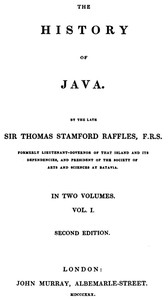
The History of Java, v. 1-2 by Sir Thomas Stamford Raffles
Sir Thomas Stamford Raffles is best known as the founder of Singapore, but his time as Lieutenant-Governor of Java (1811-1816) produced this monumental work. These two volumes are his attempt to document everything about the island—its people, nature, history, and arts—before, as he feared, it was lost to rapid change.
The Story
There isn't a traditional plot, but there is a clear narrative drive. Raffles structures his work like a grand tour. Volume One introduces you to the island itself: its volcanoes, wildlife, and agriculture. Then he walks you through Javanese society, from the courts of the Sultans to the daily life in villages. He explains customs, religions (Islam layered over older Hindu-Buddhist traditions), and the complex way the island was governed. Volume Two gets into the real treasure: culture. Here, he dives deep into language, music, puppetry (wayang), and literature. He includes translations of ancient poems and records of court ceremonies. The whole project feels like he's holding up a giant net, trying to catch a whole world in its mesh before it slips away.
Why You Should Read It
What makes this book special is the voice behind it. Yes, Raffles was a British imperial officer, and that perspective is always there. But you also get a man who is genuinely awestruck. His descriptions of Borobudur (which was mostly buried at the time) are filled with wonder. He argues passionately for the sophistication of Javanese law and art. You see him trying to balance his duty to the British Empire with his admiration for the civilization he's governing. It's this contradiction that makes it so readable. You're not just learning about 19th-century Java; you're witnessing one man's passionate, imperfect attempt to understand and preserve it. The book is packed with surprising details—from how to grow pepper to the philosophy behind shadow plays—that bring the era to life.
Final Verdict
This is not a quick read, but it's a profoundly rewarding one. It's perfect for history buffs who want to go beyond European-centered narratives, for travelers with a deep curiosity about Southeast Asia, and for anyone interested in the complex, often messy, relationships between colonizer and colonized. Don't expect a modern, critical history. Instead, read it as a primary source—a lavish, detailed, and personal portrait of a place at a crossroads, painted by a man who was both an agent of change and its most attentive observer. You'll come away with a richer, more nuanced picture of Java, and of Raffles himself.
There are no legal restrictions on this material. Knowledge should be free and accessible.
John Garcia
1 year agoI particularly value the technical accuracy maintained throughout.
Sandra Davis
1 year agoHaving read this twice, the plot twists are genuinely surprising. I couldn't put it down.
Lisa Harris
1 year agoClear and concise.
Patricia Johnson
3 months agoThis book was worth my time since the pacing is just right, keeping you engaged. Absolutely essential reading.







Karen Wilson
1 year agoThe digital formatting makes it very easy to navigate.