
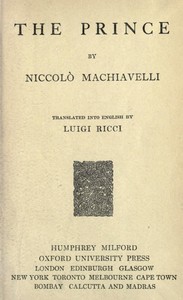
The Prince by Niccolò Machiavelli
Let's be clear: The Prince is not a novel. There's no plot in the traditional sense. Think of it as the ultimate guidebook, written in 1513 by Niccolò Machiavelli, a Florentine diplomat who'd just been fired, tortured, and exiled. Desperate to get back into the game, he wrote this as a gift for Lorenzo de' Medici, the new ruler of Florence. It was his pitch: 'I know how this works. Let me show you.'
The Story
The 'story' here is the argument. Machiavelli walks his prince through every step of ruling. He talks about different types of states (new vs. inherited, free vs. conquered) and the specific strategies for each. He uses real examples from recent history—Cesare Borgia, Pope Alexander VI—to show what success and failure look like. The core of the book is a series of stark, practical lessons. A leader must study war above all else. It's safer to be feared than loved, if you can't be both. Sometimes you have to act against mercy, faith, and humanity to keep your state secure. He separates the ideal world from the real world, arguing that to do good, a prince must sometimes be prepared to do bad.
Why You Should Read It
I picked this up expecting a dry political manual. I was wrong. It's electrifying. Machiavelli doesn't waste time on what *should* be; he obsesses over what *is*. His bluntness is refreshing, even when it's unsettling. Reading it, you start to see his logic everywhere—in corporate boardrooms, in sports teams, even in school politics. The book forces you to ask hard questions about ethics, success, and the messy reality of leadership. Is he cynical, or just realistic? That debate is half the fun. It's less about agreeing with him and more about understanding a worldview that has influenced leaders (for better or worse) for centuries.
Final Verdict
This is a must-read for anyone curious about power, history, or human nature. It's perfect for the politically minded, the aspiring leader, or the reader who loves a good, provocative argument. It's also surprisingly short and direct—you can finish it in a couple of sittings. Just be warned: it might make you a little more skeptical of people in charge. Approach it not as a moral compass, but as an X-ray of political survival. Five hundred years later, it still hits a nerve.
This publication is available for unrestricted use. You do not need permission to reproduce this work.



Margaret Gonzalez
11 months agoHaving read this twice, the emotional weight of the story is balanced perfectly. Absolutely essential reading.