About 256 minutes
Two Little Women and Treasure House — Edition Insights
Fantasy Juvenile Worlds
58,762 recorded words. 1 minutes difference from this book's estimate.
View Gutenberg source #56632
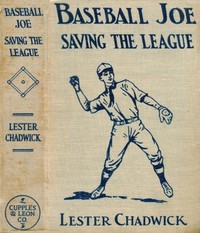
Baseball Joe Saving the League; or, Breaking Up a Great Conspiracy — Story, Setting & Ideas can be approached with a clearer sense of reading commitment from its source measurements: 58,471 words, 4 hr 15 min estimated reading time, and 31 detected text sections.
The text analysis averages about 17.0 words per sentence, while the detected sections provide another way to judge how the source is divided.
Project Gutenberg metadata also associates the work with “Conduct of life -- Juvenile fiction,” connecting these edition facts with the source record’s subject description.
Explore this collection
These alternatives are selected using recorded categories and estimated reading time.
About 256 minutes
Fantasy Juvenile Worlds
58,762 recorded words. 1 minutes difference from this book's estimate.
View Gutenberg source #56632About 257 minutes
Fantasy Juvenile Worlds
59,072 recorded words. 2 minutes difference from this book's estimate.
View Gutenberg source #67430About 261 minutes
Fantasy Juvenile Worlds
60,010 recorded words. 6 minutes difference from this book's estimate.
View Gutenberg source #65552Search stored excerpts and compare books → Choose by your preferences →
Choices use stored catalog measurements. Estimates vary with reading speed. A shared category is a catalog label, not a claim that two books have the same argument or literary quality.
Search reads excerpt text stored with this catalog and links to its associated Gutenberg record. The connection is stored in the site database; this tool does not recheck that every excerpt is word-for-word identical to that external record. Excerpt search does not cover every chapter and does not verify historical publication dates.
Catalog snapshot checked: 2026-09-25. Coverage: 91 public books, 91 available source excerpts.
Read the complete public-domain text at its original source.
Read on Project GutenbergThe story opens with a casual exchange between Joe Matson and his teammate Jim Barclay about Joe's pitching arm, described as a "soup bone" and "fine as a fiddle." This colloquial banter quickly gives way to tension when a suspicious telegram arrives, claiming Joe's wife Mabel is ill. Jim suspects a plot to lure Joe away from a crucial game, noting an unsigned message and a "grin that passed between Hupft and McCarney." The scene shifts from the locker room to McRae's office, where Joe frantically tries to call Riverside, only to find the line dead. The structure alternates between dialogue-driven urgency and moments of hesitation, with Joe's shaking hand and watch-checking underscoring his anxiety.
The unsigned telegram is the story's first major turning point. Jim Barclay immediately labels it "phony," pointing to its timing and lack of signature. Joe's reaction—pulling out his watch, shaking hands, and groaning about wasted time—shows how the message disrupts his focus. The telephone call to Riverside fails, heightening the suspense. This sequence establishes a pattern: characters must interpret incomplete information under pressure. The telegram is not just a message but a weapon, used by unseen conspirators to manipulate Joe's actions. The narrative lingers on the physical details of waiting—"moments, hours, it seemed to Joe"—before the call's failure forces a decision.
The excerpts are rich with baseball-specific vocabulary: "soup bone" for arm, "twirler" for pitcher, "whitewash" for a shutout, and "in the hole" for a batter's disadvantage. Joe's warm-up—flexing his biceps and swinging his arm—is described with mechanical precision. The dialogue between Joe and Jim uses insider terms like "king boxman" and "plastering the whitewash on the Dodgers." This language roots the story in the sport's culture, but it also serves characterization: Joe's confidence in his "mighty right arm" contrasts with his later panic. The physicality extends to gestures: Jim puts an "imperative hand on Joe's arm," and Joe "stared at Jim as though he were seeing him for the first time."
The narrative moves rapidly between locations: the locker room, McRae's office, and the telephone. Each space has a distinct function. The locker room is for casual talk and preparation; the office becomes a site of conflict and decision-making; the telephone is a point of failure. Joe's journey from the locker room to the office is described in a single sentence: "He followed his chum toward McRae's office." Once there, the action centers on the telephone, with Joe "raging inwardly at the delay." The shift from private anxiety to public confrontation occurs when McRae enters, asking about Joe's "glad rags." This movement between spaces mirrors the plot's oscillation between personal loyalty and team duty.
When the telephone fails, Jim suggests contacting Reggie, a friend staying near Riverside. Joe reluctantly agrees, calling Reggie's number "more with the idea of pacifying McRae and Jim than from any hope of help." Reggie's introduction is brief but significant: he is defined by his location (Ridersville) and his connection to Joe and Jim. The chapter title "Reggie to the Rescue" hints at his role, but the excerpt ends before his arrival. This pivot from direct action to indirect communication—using a proxy—shifts the story's momentum. Reggie represents a potential solution, but the narrative withholds his effectiveness, keeping the tension unresolved.
The excerpts reveal a story built on rapid scene changes and the pressure of incomplete information. Readers should pay attention to how the author uses telegrams, telephone calls, and physical gestures to create suspense. The baseball setting is not just background but a source of vocabulary and pacing. The conspiracy hinted at in the title unfolds through small clues—a grin, an unsigned message—rather than grand revelations. This structure rewards close attention to dialogue and movement between spaces.
There’s something about that old pitcher's stubborn calm—letters arriving, schemes closing in—that pulled me back to a summer porch, reading late. I remembered Strong and Steady; Or, Paddle Your Own Canoe — A Closer Reading, and how its quiet resolve felt like the same steady hand, holding firm against whatever the tide brought.
Your answers remain private and are stored only in this browser.









