About 263 minutes
Mark Tidd in the Backwoods — Reading Companion
Fantasy Juvenile Worlds
60,269 recorded words. 2 minutes difference from this book's estimate.
View Gutenberg source #57197
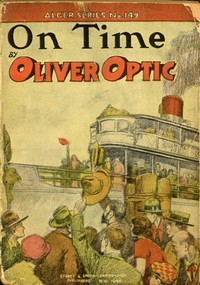
The catalog record for On Time; or, Bound to Get There — Reading Companion provides practical reading context through 60,010 words, 4 hr 21 min estimated reading time, and 37 detected text sections.
The text analysis averages about 16.2 words per sentence, while the detected sections provide another way to judge how the source is divided.
Project Gutenberg metadata also associates the work with “Christian life -- Juvenile fiction,” connecting these edition facts with the source record’s subject description.
Explore this collection
These alternatives are selected using recorded categories and estimated reading time.
About 263 minutes
Fantasy Juvenile Worlds
60,269 recorded words. 2 minutes difference from this book's estimate.
View Gutenberg source #57197About 257 minutes
Fantasy Juvenile Worlds
59,072 recorded words. 4 minutes difference from this book's estimate.
View Gutenberg source #67430About 256 minutes
Fantasy Juvenile Worlds
58,762 recorded words. 5 minutes difference from this book's estimate.
View Gutenberg source #56632Search stored excerpts and compare books → Choose by your preferences →
Choices use stored catalog measurements. Estimates vary with reading speed. A shared category is a catalog label, not a claim that two books have the same argument or literary quality.
Search reads excerpt text stored with this catalog and links to its associated Gutenberg record. The connection is stored in the site database; this tool does not recheck that every excerpt is word-for-word identical to that external record. Excerpt search does not cover every chapter and does not verify historical publication dates.
Catalog snapshot checked: 2026-09-25. Coverage: 91 public books, 91 available source excerpts.
Read the complete public-domain text at its original source.
Read on Project GutenbergThe first chapter, “A New Project,” drops the reader directly into a steamboat captain’s world of schedules and competition. The narrator, Wolf Penniman, is already commanding the Ucayga and measuring success by minutes: the train is “ten minutes behind time,” and his boat must beat it. This early focus on punctuality—the title’s promise—is not merely a plot device but a moral framework. When Wolf raises wages to prevent “a conspiracy against the new order of things,” the text links reliability with fairness and leadership.
The excerpts show a story built around practical decisions: hiring a friend, managing a subordinate, and keeping a promise to passengers. The setting—a lake with steamboats, a railroad, and towns like Centreport and Middleport—is drawn with specific geography. Readers should note how the author uses timetables and travel logistics to create tension, not just background.
The narrator speaks in a direct, confident first person. He evaluates people by their competence and character: Tom Walton is “a thorough and competent boatman,” while the former management of the boat is something to improve. Wolf’s internal commentary reveals a code of conduct—he rewards faithfulness, removes “grounds for jealousy,” and plans for the future. This voice is consistent across the excerpts, suggesting the book’s moral lessons are delivered through action and reflection, not sermonizing.
Notice how Wolf describes his subordinate Van Wolter: “I was glad that I had so soon removed all grounds for jealousy.” The phrasing shows a leader who anticipates problems. Readers can watch for how this practical wisdom guides the plot, especially when conflicts arise with the Toppleton Battalion or the rival steamer.
The central tension in the opening chapters is the race against the Lightning Express. Wolf’s steamer “had beaten the Lightning Express” for the first time, and the crew intends to “keep doing it.” This competition is not just a race but a business: passengers trust the boat’s promise to connect with the up-lake steamer at Centreport. The text emphasizes that such promises are not always safe to keep, hinting at future risks.
The railroad and steamboat are intertwined systems. The train arrives at Middleport while the boat docks at Centreport; timing is everything. This logistical puzzle gives the story a concrete, problem-solving energy. Readers should note how the author uses real constraints—distance, speed, schedules—to build suspense, rather than relying on fantasy or coincidence.
Major Tommy Toppleton appears mounted on a pony, still recovering from a broken leg, and immediately confronts Wolf with the words “You villain, Wolf Penniman!” The scene is comic but also adversarial: Tommy urges his pony “as though he intended to crush me.” This introduces a personal antagonist whose style contrasts sharply with Wolf’s measured leadership.
Tom Walton, by contrast, is introduced as a “splendid fellow” devoted to his poor, ill mother. The text describes his home as “one of the smallest and meanest dwellings in Middleport,” grounding his character in economic reality. These two figures—the wealthy, impulsive major and the deserving, hardworking friend—set up a moral spectrum. Readers can anticipate that Wolf’s choices between them will test his values.
The Ucayga is more than a setting; it is a platform for Wolf’s authority and judgment. He gives orders, raises wages, and plans for the winter. The boat’s success depends on his decisions, from hiring to scheduling. The excerpt shows him delegating to Van Wolter and then crossing the lake to visit Tom Walton’s mother—a move that blends duty with friendship.
Notice how the narrative lingers on practical details: “the boat going up the lake had not yet left the pier,” “we were fast to the wharf.” These specifics create a world where every action has a consequence. Readers should pay attention to how Wolf’s promises—to the colonel, to Tom, to the passengers—drive the story forward. The book’s title, On Time; or, Bound to Get There, suggests that keeping one’s word is the ultimate test.
These excerpts reveal a story that rewards careful reading of its practical details. The race against the train, the management of crew and rivals, and the contrast between characters like Tommy Toppleton and Tom Walton all point to a central theme: reliability as a form of integrity. Readers who track the promises Wolf makes—and whether he keeps them—will find the book’s moral architecture. The geography of the lake and the rhythm of steamboat travel are not decoration but the very engine of the plot.
There’s something tender about old tales where time itself feels like a moral compass, every missed bell a quiet lesson in character. Reading about young Wolf’s punctual pursuit reminded me of that softer ache in Mopsa the Fairy — Themes and Context, where hours slip sideways altogether. We grow older, and still, those childhood clocks keep their own gentle, unkept promise.
Capture what you thought, learned, and would like to remember.









