About 199 minutes
Peggy Goes Straw Hat — Text and Context
Fantasy Juvenile Worlds
45,682 recorded words. 3 minutes difference from this book's estimate.
View Gutenberg source #55826
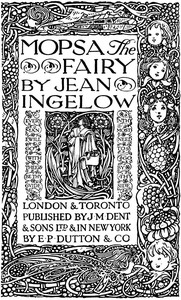
Mopsa the Fairy — Themes and Context can be approached with a clearer sense of reading commitment from its source measurements: 46,415 words, 3 hr 22 min estimated reading time, and 21 detected text sections.
The text analysis averages about 20.6 words per sentence, while the detected sections provide another way to judge how the source is divided.
Project Gutenberg metadata also associates the work with “Fairy tales,” connecting these edition facts with the source record’s subject description.
Explore this collection
These alternatives are selected using recorded categories and estimated reading time.
About 199 minutes
Fantasy Juvenile Worlds
45,682 recorded words. 3 minutes difference from this book's estimate.
View Gutenberg source #55826About 196 minutes
Fantasy Juvenile Worlds
45,038 recorded words. 6 minutes difference from this book's estimate.
View Gutenberg source #58292About 214 minutes
Fantasy Juvenile Worlds
49,117 recorded words. 12 minutes difference from this book's estimate.
View Gutenberg source #63535Search stored excerpts and compare books → Choose by your preferences →
Choices use stored catalog measurements. Estimates vary with reading speed. A shared category is a catalog label, not a claim that two books have the same argument or literary quality.
Search reads excerpt text stored with this catalog and links to its associated Gutenberg record. The connection is stored in the site database; this tool does not recheck that every excerpt is word-for-word identical to that external record. Excerpt search does not cover every chapter and does not verify historical publication dates.
Catalog snapshot checked: 2026-09-25. Coverage: 91 public books, 91 available source excerpts.
Read the complete public-domain text at its original source.
Read on Project GutenbergJean Ingelow's Mopsa the Fairy opens not with a conventional introduction to its young hero, Jack, but with a framing device that signals the story's layered nature. The Everyman's Library edition includes an introduction tracing Ingelow's early influences, from the Taylor sisters' child-rhymes to the Lincolnshire fen country that shaped her imagination. The first excerpt finds Jack already in Fairyland, conversing with an apple-woman who once wished for satin gowns and coaches, only to grow weary of having everything she desired. This early scene establishes a central tension: in Fairyland, the ability to have any wish granted paradoxically leads to indifference, and the Queen herself moves blindly, murmuring prophecies that the apple-woman warns Jack not to hear.
The apple-woman's story offers a compressed lesson in Fairyland's psychology. She explains that when she first arrived, she could have "a hundred and fifty satin gowns" and "twenty coaches with six cream-coloured horses to each," but soon found she "began not to care for anything." Her solution—to dress in her old clothes and sell apples as she used to—reveals a longing for the ordinary that Fairyland cannot satisfy. Yet she cannot bring herself to wish her way home, fearing poverty, her sons' forgetfulness, or neighbours' scorn. This paralysis echoes the Queen's muttered remark that "Fate is the name of my old mother, and she reigns here." The apple-woman's predicament suggests that Fairyland's magic does not liberate but traps its inhabitants in a state of suspended desire, where the very power to change one's circumstances becomes a burden.
The Queen of Fairyland moves "with her hands held out before her, as if it was dark," telling stories of what is going to happen. Jack overhears fragments: "So he took the measure, and Mopsa stood still for once, and he found she was only one foot high, and she grew a great deal after that." The apple-woman urges Jack not to listen, and begins to sing loudly to drown out the Queen's words. This interplay of song and prophecy creates a layered soundscape: the apple-woman's ballad of a ship coming up the river—with its refrain "pull'e haul'e, pull'e haul'e, yoy! heave, hoy!"—competes with the Queen's ongoing murmur. The effect is disorienting, suggesting that in Fairyland, knowledge of the future is both available and dangerous. The Queen's blindness and her constant storytelling imply that fate is not a fixed script but a narrative being composed aloud, one that listeners may inadvertently alter or fulfill by hearing it.
The apple-woman's song, printed in full in the excerpt, is a nostalgic vision of a ship arriving at a wooden wharf, with "a jolly gang of towers" and the creaking capstan. Its refrain mimics the rhythm of labour: "pull'e haul'e, pull'e haul'e, yoy! heave, hoy!" The song transports her back to a time before Fairyland, when she was invited aboard: "'Will ye step aboard, my dearest? for the high seas lie before us.'" This memory of movement and purpose contrasts sharply with the static, satiated existence of Fairyland. The song functions as a counter-spell, not only drowning out the Queen's prophecies but also reasserting a world of cause and effect, where effort yields result. Ingelow's use of verse within prose is characteristic: the ballad form provides a rhythmic anchor amid the Queen's drifting monologue, and its concrete imagery—the ship, the wharves, the buoy—grounds the reader in the tangible world Jack has left behind.
The excerpts establish that Fairyland operates on rules that are both arbitrary and rigid. The apple-woman can have anything she wishes, but the wishing itself becomes impossible when she most needs it. The Queen tells stories of what will happen, yet the apple-woman treats these as forbidden knowledge. Mopsa, the fairy of the title, is mentioned only briefly: she is "one foot high" and "can grow," suggesting a being in flux. The apple-woman's final warning—"Don't let her see us talking together, lest she should think I have been telling you things which you ought not to know"—implies that even casual conversation is subject to surveillance. These details, drawn from the opening chapters, hint at a world where information is controlled, desire is thwarted by its own fulfillment, and the boundary between prophecy and interference is porous. Readers should attend to these early clues, as they likely shape Jack's subsequent adventures.
As you read Mopsa the Fairy, pay close attention to the songs and stories embedded in the prose. Ingelow often uses verse to mark moments of emotional truth or to contrast with the Queen's ambiguous prophecies. The apple-woman's ballad, with its refrain of labour and arrival, may serve as a key to understanding how Jack can navigate a land where wishes lose their meaning. Notice also how characters speak of fate and choice: the Queen's mother Fate "reigns here," but the apple-woman's inability to wish herself home suggests that agency is not simply absent but complicated by memory and attachment.
That rainy afternoon, I kept returning to the apple-woman’s riddles about wishes losing their power—how strange it felt that desire could unravel so quietly. Later, drying the pages, I found myself thinking of another household where wanting something meant learning to wait for it, and that’s how I stumbled onto Elsie and the Raymonds — Key Ideas to Explore. The warmth lingered, almost as if the two books were old friends.
Use these questions to collect your thoughts before moving on.









