About 323 minutes
Winning his game — Edition Insights
Fantasy Juvenile Worlds
74,103 recorded words. 5 minutes difference from this book's estimate.
View Gutenberg source #69206
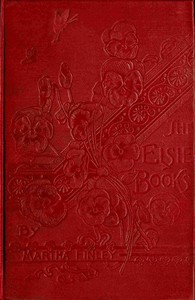
The source record for Elsie and the Raymonds — Key Ideas to Explore measures this digital text at 75,246 words, 5 hr 28 min estimated reading time, and 24 detected text sections.
The text analysis averages about 19.1 words per sentence, while the detected sections provide another way to judge how the source is divided.
Project Gutenberg metadata also associates the work with “Christian life -- Juvenile fiction,” connecting these edition facts with the source record’s subject description.
Explore this collection
These alternatives are selected using recorded categories and estimated reading time.
About 323 minutes
Fantasy Juvenile Worlds
74,103 recorded words. 5 minutes difference from this book's estimate.
View Gutenberg source #69206About 318 minutes
Fantasy Juvenile Worlds
72,952 recorded words. 10 minutes difference from this book's estimate.
View Gutenberg source #67397About 314 minutes
Fantasy Juvenile Worlds
72,003 recorded words. 14 minutes difference from this book's estimate.
View Gutenberg source #56834Search stored excerpts and compare books → Choose by your preferences →
Choices use stored catalog measurements. Estimates vary with reading speed. A shared category is a catalog label, not a claim that two books have the same argument or literary quality.
Search reads excerpt text stored with this catalog and links to its associated Gutenberg record. The connection is stored in the site database; this tool does not recheck that every excerpt is word-for-word identical to that external record. Excerpt search does not cover every chapter and does not verify historical publication dates.
Catalog snapshot checked: 2026-09-25. Coverage: 91 public books, 91 available source excerpts.
Read the complete public-domain text at its original source.
Read on Project GutenbergThe novel begins not with Elsie herself but with Lulu Raymond, who is addressed by a timid seamstress on a city street. The contrast between Lulu's rosy health and the girl's 'pale, pinched features' establishes a recurring pattern: Finley uses physical description to telegraph moral and social standing. The opening dialogue is hesitant, full of dashes and choked words, a voice that will not reappear once the scene shifts to the Raymond family's domestic interior.
Inside the home, the prose relaxes into a different register. A father corrects his children's spelling by refusing to be a living dictionary, insisting on self-help. The lesson is delivered with 'sportive look and tone,' and the children respond with laughter. Finley's narrative voice here is patient, almost leisurely, as she tracks the small rituals of letter-writing and the comparative speed of pens scratching across paper.
The seamstress's opening speech is the only moment in the excerpts where the prose strains toward naturalism. Her words are broken by hesitation—'Excuse me, Miss, but do you know of any lady who wants a seamstress?'—and her need is stated plainly: 'I need work badly; mother's sick, and we've only what I can earn to depend on.' Finley does not dwell on this suffering; Lulu promises to ask her mother, and the carriage rolls away. The narrative then turns to the Raymonds' hotel suite, where the father, a captain, presides over a scene of composed domesticity. The shift is abrupt, as if the street encounter were a brief disturbance quickly smoothed over.
Inside, the children write letters to their sister Gracie. The father suggests they compare accounts afterward, so that 'between the two letters Gracie will get a better idea of the little excursion.' This moment reveals Finley's interest in multiple perspectives within a single event, a technique she uses sparingly. The children's pens scratch at different speeds—Max finishes first, Lulu lingers over details—and the father's comment that 'that is just what Gracie will enjoy' gently validates a more expansive style of narration.
Finley's didacticism is woven into dialogue that feels both staged and affectionate. When Lulu asks what to do without a dictionary, her father offers himself as a substitute, then immediately qualifies the offer: 'I think the spelling will be more likely to be impressed upon your memory by the trouble of having to search out the word.' The lesson is explicit—'We should never trouble others to do for us what we can do for ourselves'—but the tone remains light, with Max quickly applying the principle to success in life.
The pacing of these instructional scenes is deliberate. The father writes his letter 'more rapidly, and with fewer pauses,' while the children pause and scratch. Finley uses the physical act of writing to mirror the children's different temperaments: Max is efficient, Lulu is detailed. When Sandy announces the horses, Lulu's dismay at her unfinished letter is met with a calm redirection: 'Lay it in your writing-desk and put on your hat.' The rhythm of the day—shopping, writing, riding, rest—is governed by the father's schedule, and the narrative moves at his measured pace.
A curious digression occurs during the ride when Max remarks that tradesmen often have names matching their occupations: 'Mr. Shoemaker a hotel keeper, and so on.' His father counters with a Mr. Cobbler who 'made, and doubtless mended, shoes, too.' Lulu then recalls the Browns, who 'were all very fair,' and Tom White, who 'was dark-complexioned.' This exchange is a brief, self-contained puzzle about the arbitrariness of names versus the expectation of fit. It has no bearing on the plot, but it shows Finley's willingness to let characters play with language.
The same playful attention appears in the father's offer to be a 'living dictionary' and in Max's teasing about Lulu's hat: 'Better tie that hat on tight, Lu; he may rear and make it fall off, if he doesn't throw you.' The banter is gentle, and the children's laughter is recorded without comment. These moments of verbal play are the novel's lightest passages, standing in contrast to the seamstress's choked plea and the earnest spelling lesson. Finley moves between these registers without signaling the shift, trusting the reader to follow.
Readers approaching Elsie and the Raymonds should attend to the way Finley modulates pace between public encounters and private instruction. The seamstress's voice, heard only once, is a reminder of the world outside the family circle; the rest of the excerpts are spent inside that circle, where lessons are delivered with affection and the day's schedule is a form of moral order. The novel's interest in names, writing, and the comparison of accounts suggests that Finley is as concerned with how stories are told as with what they teach.
Odd, how differently two books can breathe — Elsie and the Raymonds hums with letters and quiet lessons, its father gently steering a child toward self-reliance, while the linked Baseball Joe Saving the League; or, Breaking Up a Great Conspiracy — Story, Setting & Ideas find its own boy trusting his instincts amid a hurried plot. Both simply trust a young heart’s steady compass. I liked that.
Use these questions to collect your thoughts before moving on.









