
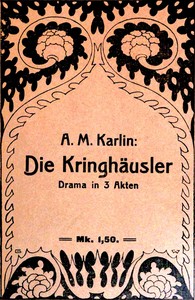
Die Kringhäusler: Drama in drei Akten by Alma M. Karlin
Alma M. Karlin's Die Kringhäusler (which translates to 'The Circle House Dwellers') is a three-act play that pulls you into a world where tradition is a prison and community is a cage. Written in the early 20th century, it feels incredibly relevant today as it examines fear, belonging, and the cost of conformity.
The Story
The play is set in a remote mountain village. Life here follows centuries-old patterns, governed by unspoken rules and a deep distrust of the world beyond the valley. The fragile peace shatters when a stranger arrives. He might be a traveler, a thinker, or just someone from a different place—but his mere existence is a threat to the village's insulated way of life. As the villagers react, we see alliances fracture, hidden prejudices rise, and long-buried secrets threaten to come out. The drama unfolds not with shouting matches, but through tense conversations, loaded silences, and the heavy weight of collective judgment. The central question isn't just about the stranger's fate, but whether the village itself can survive the confrontation with a new idea.
Why You Should Read It
What grabbed me was Karlin's sharp eye for human psychology. She doesn't paint the villagers as simple villains; she shows how fear and isolation twist good intentions. You understand why they cling to their 'circle,' even as you wince at their actions. The characters feel real—the cautious elder, the restless youth, the person who secretly wonders if there's more to life. Karlin, having traveled the globe solo as a woman in the 1920s, writes about the outsider's perspective with genuine authority. The play moves at a deliberate pace, building a dense atmosphere that makes the eventual conflicts hit harder. It’s less about what happens, and more about watching the pressure build until something has to give.
Final Verdict
This is a perfect pick for readers who love character-driven dramas and social parables. If you enjoyed the creeping tension of Shirley Jackson's The Lottery or the exploration of insular communities in novels like The Crucible, you'll find a lot to love here. It's also a fascinating piece of literary history from a remarkable and often-overlooked author. Be prepared for a thoughtful, atmospheric read that sticks with you, making you question the invisible 'circles' we all live within.
This content is free to share and distribute. You do not need permission to reproduce this work.
Charles Martin
1 year agoHelped me clear up some confusion on the topic.
Richard Martin
5 months agoGreat digital experience compared to other versions.
Emily Hill
1 year agoI stumbled upon this title and the content flows smoothly from one chapter to the next. Thanks for sharing this review.
Ethan Walker
2 years agoI was skeptical at first, but the flow of the text seems very fluid. Worth every second.

John Hernandez
1 year agoThe fonts used are very comfortable for long reading sessions.