
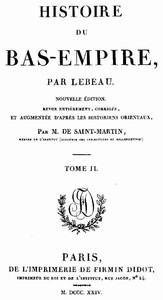
Histoire du Bas-Empire. Tome 02 by Charles Le Beau
Charles Le Beau's second volume picks up the story of Rome's later centuries, a period often glossed over. This isn't about the glory of Augustus or the madness of Nero. This is the gritty, complicated era where the Roman Empire in the West fights for its last breaths.
The Story
Le Beau guides us through a relentless parade of short-lived emperors, military strongmen, and invading tribes. The plot, because history is the ultimate plot, follows the empire's fragmentation. Central authority crumbles. Ambitious generals in places like Gaul or Britain declare themselves emperor, draining resources and loyalty from Rome. Meanwhile, groups like the Visigoths, Vandals, and Huns aren't just attacking the borders anymore—they're settling inside, making deals, breaking them, and carving out their own kingdoms. The narrative moves from the court of Ravenna (the new capital) to the battlefields of Africa and the streets of a Rome that gets sacked... twice. It's a chronicle of survival, adaptation, and the painful birth of what we'd later call medieval Europe.
Why You Should Read It
What makes this old history feel fresh is the sheer human drama. Le Beau, writing in the 18th century, has a point of view. You feel his fascination and sometimes his dismay at the choices made. He highlights moments of stunning bravery and staggering shortsightedness. It's impossible not to draw parallels to any large institution or nation that overextends itself and fails to adapt. The characters, from the tragic figure of the last Western emperor, Romulus Augustulus, to the cunning Vandal king Gaiseric, are compelling because their decisions had real, world-altering consequences. You're not just reading dates; you're watching a domino fall that set off a chain reaction for a thousand years.
Final Verdict
This is for the patient history lover who wants to go beyond the simple headline. It's not a breezy novel; it's a detailed, sometimes dense, chronological account. But if you're fascinated by pivotal 'what went wrong?' moments in history, or if you love complex political and military strategy, this is a treasure trove. Perfect for readers who enjoyed Gibbon's Decline and Fall but want a more focused, blow-by-blow account of the final act. You'll come away with a deep appreciation for how chaotic, contingent, and human the end of an era truly was.
This title is part of the public domain archive. Feel free to use it for personal or commercial purposes.
James Harris
7 months agoGreat reference material for my coursework.
Noah Harris
1 year agoAfter finishing this book, the atmosphere created is totally immersive. Exactly what I needed.
James Wilson
1 year agoNot bad at all.
Brian Jones
8 months agoAs someone who reads a lot, the character development leaves a lasting impact. Truly inspiring.



Amanda Ramirez
1 year agoSolid story.