About 400 minutes
Bashful Fifteen — Context and Discussion
Fantasy Juvenile Worlds
91,870 recorded words. 41 minutes difference from this book's estimate.
View Gutenberg source #61857
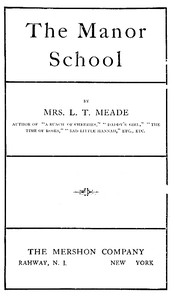
Before opening The Manor School — Reading Companion, the edition data offers a quick orientation: 101,373 words, 7 hr 21 min estimated reading time, and 10 detected text sections.
The text analysis averages about 13.1 words per sentence, while the detected sections provide another way to judge how the source is divided.
Project Gutenberg metadata also associates the work with “Boarding schools -- England -- Juvenile fiction,” connecting these edition facts with the source record’s subject description.
Explore this collection
These alternatives are selected using recorded categories and estimated reading time.
About 400 minutes
Fantasy Juvenile Worlds
91,870 recorded words. 41 minutes difference from this book's estimate.
View Gutenberg source #61857About 393 minutes
Fantasy Juvenile Worlds
90,276 recorded words. 48 minutes difference from this book's estimate.
View Gutenberg source #56216About 385 minutes
Fantasy Juvenile Worlds
88,438 recorded words. 56 minutes difference from this book's estimate.
View Gutenberg source #57408Search stored excerpts and compare books → Choose by your preferences →
Choices use stored catalog measurements. Estimates vary with reading speed. A shared category is a catalog label, not a claim that two books have the same argument or literary quality.
Search reads excerpt text stored with this catalog and links to its associated Gutenberg record. The connection is stored in the site database; this tool does not recheck that every excerpt is word-for-word identical to that external record. Excerpt search does not cover every chapter and does not verify historical publication dates.
Catalog snapshot checked: 2026-09-25. Coverage: 91 public books, 91 available source excerpts.
Read the complete public-domain text at its original source.
Read on Project GutenbergThe opening chapter, 'The Attic of Desire,' immediately establishes a private, imaginative realm for thirteen-year-old Christian Mitford. In the vast attics of her Russell Square home, she orchestrates elaborate lives for her twelve dolls, treating their adventures—such as Rosabel running away to the gypsies—as matters of course. This domestic fantasy world stands in sharp contrast to the social dynamics that later unfold at The Manor School, where Christian becomes entangled with Susan Marsh, a girl who wields a mincing, hymn-like tone as a weapon of manipulation. The narrative voice shifts between Christian's internal perspective and the clipped, theatrical dialogue of the schoolgirls, creating a tension between innocence and calculated cruelty.
Christian's attic is not merely a playroom but a domain where she exercises absolute authority. The narrator notes that she 'kept her dolls' there and that 'the adventures those dolls went through would have delighted any other little girl; Christian took these things as a matter of course.' This detachment suggests a child who has learned to impose order on her world through imaginative rule-making. The attic's description—'enormous, lofty rooms, wide halls, great corridors'—echoes the scale of the school later, but here Christian is sovereign. The contrast between her controlled fantasy and the unpredictable social world of the school underscores a central tension: the loss of autonomy when she leaves her private realm.
Susan Marsh's dialogue is marked by a distinctive, almost singsong quality. When she approaches Christian, she 'said in a mincing voice, and in the tone of a person drawling out a hymn: “Come hither, little Christian, / And hearken unto me; / I'll tell you what the daily life / Of a Christian child should be.”' This poetic coercion contrasts with the blunt, fearful exchanges of other girls. Susan uses endearments ('love,' 'darling') while extracting money and compliance, a technique that reveals the school's hidden hierarchies. The narrative pace slows during these exchanges, lingering on the psychological pressure, whereas scenes with the more straightforward Maud or the honorable Star move more briskly, reflecting differing moral weights.
The novel alternates between Christian's solitary reflections and crowded school scenes. In the attic chapters, the prose is expansive, dwelling on the dolls' histories and Christian's inner life. Once the setting shifts to The Manor School, the pace quickens with rapid dialogue and conspiratorial planning. For instance, Susan's scheme to use Christian's sovereign for a secret supper introduces a flurry of whispered plans and moral qualms from Maud. The narrator occasionally inserts direct commentary—'Now, this was the very last thing that Susan wished'—which briefly pauses the action to clarify motives. These shifts in tempo mirror Christian's own oscillation between passive observation and active resistance.
Readers attentive to voice will notice how Meade differentiates characters through speech rhythms: Susan's artificial cadence, Maud's hesitant protests, and Christian's blunt refusals. The excerpts suggest that the novel's moral drama unfolds less through overt events than through the subtle pressure of words—a hymn turned into a threat, a sovereign extracted as a 'price of detention.' Pay attention to how the narrative lingers on moments of decision, as these pauses often carry more weight than the subsequent action.
The secret societies at The Manor School reminded me of my own sixth-grade alliances, brittle with whispered threats. I remember finishing this and reaching for Wolf Ear the Indian: A story of the great uprising of 1890-91 — Text and Context, feeling the same strange ache—how power moves through groups, how quietly a lone voice gets lost.
Use these questions to collect your thoughts before moving on.









