About 304 minutes
Whistler; or, The Manly Boy — Story, Setting & Ideas
Science Fiction Utopias
69,761 recorded words. 18 minutes difference from this book's estimate.
View Gutenberg source #67723
For Baron Trump's Marvellous Underground Journey — Reading Notes, the stored edition analysis reports 73,926 words, 5 hr 22 min estimated reading time, and 36 detected text sections.
The text analysis averages about 28.5 words per sentence, while the detected sections provide another way to judge how the source is divided.
Project Gutenberg metadata also associates the work with “Fantasy fiction,” connecting these edition facts with the source record’s subject description.
Explore this collection
These alternatives are selected using recorded categories and estimated reading time.
About 304 minutes
Science Fiction Utopias
69,761 recorded words. 18 minutes difference from this book's estimate.
View Gutenberg source #67723About 294 minutes
Science Fiction Utopias
67,560 recorded words. 28 minutes difference from this book's estimate.
View Gutenberg source #57165About 268 minutes
Science Fiction Utopias
61,535 recorded words. 54 minutes difference from this book's estimate.
View Gutenberg source #63619Search stored excerpts and compare books → Choose by your preferences →
Choices use stored catalog measurements. Estimates vary with reading speed. A shared category is a catalog label, not a claim that two books have the same argument or literary quality.
Search reads excerpt text stored with this catalog and links to its associated Gutenberg record. The connection is stored in the site database; this tool does not recheck that every excerpt is word-for-word identical to that external record. Excerpt search does not cover every chapter and does not verify historical publication dates.
Catalog snapshot checked: 2026-09-25. Coverage: 91 public books, 91 available source excerpts.
Read the complete public-domain text at its original source.
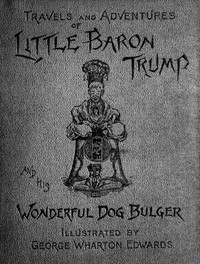
Read on Project GutenbergThe book begins not with a story but with a mock-scholarly “Biographical Notice” that insists Baron Trump was a real person, tracing his family from French Huguenot refugees to Pomeranian gentry. This framing device—complete with a portrait described in detail—sets a tone of playful authenticity. The narrator claims the baron’s travels filled his castle with “strange objects” that made peasants view him as “half bigwig and half magician.” Readers are thus primed for a tale that blends travelogue, fantasy, and a wink at credulity.
The biographical notice occupies the first several pages, establishing the baron’s lineage and reputation before any underground journey begins. Lockwood uses specific details—the revocation of the Edict of Nantes, the name changes from De la Trompe to Van der Troomp to Von Troomp—to create an air of documentary precision. The notice ends with a description of a portrait in the Stettin town hall, depicting a “man of low stature” with a “head much too large for his body” holding a carved ivory figure, his dog beside him. This portrait is offered as proof of the baron’s existence, yet its very oddness hints at the marvelous tales to come. The reader is invited to accept the fiction as fact, a game that continues throughout the narrative.
In the middle excerpts, the baron encounters the Formifolk, or Ant People, who have lost sight and hearing over generations in the sunless underworld. The learned Barrel Brow explains that his people now rely on touch, smell, and weight to identify objects. He challenges the baron to distinguish metals hidden under a kerchief, asserting that if the baron can do it, “then art thou as good a man as I.” This passage is striking for its detailed description of sensory adaptation: the Formifolk can feel a grain on a silver mirror that appears smooth to sight, and they have no words for light or sound. Lockwood uses this to invert the reader’s assumptions about which senses are superior, making the underground world a place of alternative intelligence.
The Barrel Brow recounts how, as sight faded, hearing also declined, and with it the ability to speak. The Formifolk became “blind and deaf and dumb,” communicating through touch. This evolution is presented as natural: “eternal silence… reigns in this under world,” so ears became useless. Lockwood draws a parallel to eyeless fish in rivers, grounding the fantasy in a pseudo-scientific logic. The loss of language is not portrayed as tragic but as a practical adaptation. The reader is left to consider how a society might function without sound or sight, relying entirely on tactile perception. This section challenges the primacy of vision and hearing in human experience, a theme that recurs in the baron’s interactions.
Earlier in the excerpts, the Formifolk’s ancestors built a silver civilization underground, erecting arches, bridges, and statues, all lined with candelabra. But as generations passed, their sight failed, and they became blind. The description of this decline is methodical: “great changes gradually took place,” and the people noticed their sight failing “to their inexpressible grief.” Yet the narrative does not dwell on loss; instead, it emphasizes the new abilities that emerged. The Formifolk can now “feel” the baron’s presence and describe his height and movements without touching him. This sensory compensation is presented as a marvel in itself, turning the underground world into a place of wonder rather than deprivation.
Throughout the excerpts, the baron’s dog Bulger is mentioned only briefly, but the biographical notice places him prominently: the portrait shows the baron’s “right hand rests upon the back of a dog sitting on a table and looking straight out.” In the underground journey, Bulger likely serves as a silent observer and helper, a common trope in adventure tales. The dog’s presence anchors the story in the familiar, even as the setting becomes increasingly strange. Readers should note how Bulger’s actions and reactions might mirror or contrast with the baron’s experiences, providing a non-human perspective on the Formifolk’s world.
Lockwood’s narrative rewards attention to its framing devices and the gradual revelation of the underground society’s logic. The biographical notice is not mere preamble but a key to the book’s tone—playful, learned, and slightly absurd. As you read, watch for how the baron’s encounters challenge his (and the reader’s) assumptions about normalcy. The Formifolk’s sensory world is not a disability but a different way of being, and the baron’s journey is as much about understanding as about adventure.
There’s something tender about the Formifolk’s quiet, self-made world—how they build meaning from what they can’t have. It reminds me of the easy companionship in The Rambler Club’s motor car, where the journey matters less than the steady hum of friendship beside you. The Rambler Club's motor car — Text and Context feels like an old photograph of that same unhurried trust.
Your answers remain private and are stored only in this browser.