About 268 minutes
Land and Sea Tales for Boys and Girls — A Closer Reading
Science Fiction Utopias
61,535 recorded words. 33 minutes difference from this book's estimate.
View Gutenberg source #63619
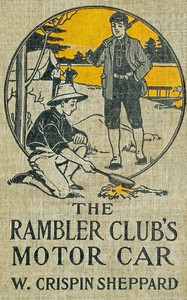
The Rambler Club's motor car — Text and Context can be approached with a clearer sense of reading commitment from its source measurements: 53,979 words, 3 hr 55 min estimated reading time, and 31 detected text sections.
The text analysis averages about 13.0 words per sentence, while the detected sections provide another way to judge how the source is divided.
Project Gutenberg metadata also associates the work with “Mystery and detective stories,” connecting these edition facts with the source record’s subject description.
Explore this collection
These alternatives are selected using recorded categories and estimated reading time.
About 268 minutes
Science Fiction Utopias
61,535 recorded words. 33 minutes difference from this book's estimate.
View Gutenberg source #63619About 194 minutes
Science Fiction Utopias
44,481 recorded words. 41 minutes difference from this book's estimate.
View Gutenberg source #67206About 294 minutes
Science Fiction Utopias
67,560 recorded words. 59 minutes difference from this book's estimate.
View Gutenberg source #57165Search stored excerpts and compare books → Choose by your preferences →
Choices use stored catalog measurements. Estimates vary with reading speed. A shared category is a catalog label, not a claim that two books have the same argument or literary quality.
Search reads excerpt text stored with this catalog and links to its associated Gutenberg record. The connection is stored in the site database; this tool does not recheck that every excerpt is word-for-word identical to that external record. Excerpt search does not cover every chapter and does not verify historical publication dates.
Catalog snapshot checked: 2026-09-25. Coverage: 91 public books, 91 available source excerpts.
Read the complete public-domain text at its original source.
Read on Project GutenbergFrom its opening pages, The Rambler Club's Motor Car establishes a distinctive narrative voice through Dave Brandon, the club's self-appointed historian. Dave's wry commentary—he initially doubts the trip will add much to his book—frames the adventure with a knowing, slightly ironic tone that contrasts with the breathless action that follows. The story quickly shifts gears, however, as a chance encounter with a traveling circus plunges the boys into a series of mishaps. Sheppard's prose becomes notably more kinetic during the circus scenes, with short, punchy sentences and sound effects—"Crack! Crack!"—that mimic the ringmaster's whip. The storm that descends mid-performance adds a layer of sensory urgency: a "dull moaning roar" outside, rain beating against canvas, and the sudden collapse of the menagerie tent. This interplay between Dave's reflective narration and the chaotic, present-tense action gives the book an uneven but engaging rhythm.
Dave Brandon serves as both participant and narrator, a dual role that Sheppard exploits for comic and structural effect. In the introduction, Dave is introduced as "poet and historian of the club," and his own skepticism about the trip's material—"will add but little to his book"—creates an ironic gap between his expectations and the reader's. This self-aware framing is unusual for a boys' adventure of the period, giving the narrative a metafictional edge. Dave's voice is consistently wry: when Victor exclaims about the circus, Dave responds with a mock-formal "Hush, lad, hush" and renames the performer Bill Potts as "Ormond de Sylveste." This playful naming underscores his role as the story's editor, shaping raw experience into a tale. Yet Sheppard does not sustain this voice uniformly; during action sequences, Dave recedes, and the prose becomes more straightforward. The result is a narrative that oscillates between commentary and immersion, reflecting the tension between telling and showing.
The storm that interrupts the circus performance is the book's most carefully paced set piece. Sheppard builds tension through layered sounds: first a "dull moaning roar," then rain pattering, then a chilly wind that sets the canvas sides swaying. The description is tactile and immediate—"dingy canvas sides swayed back and forth in the gusts"—and the boys' dialogue, with Victor's "Gee!" and Dave's measured reassurances, keeps the scene grounded. The pace accelerates as the ringmaster's whip cracks "sharply above the roar of the storm," and the horse gallops faster. Sheppard cuts between the performance and the external chaos, creating a counterpoint between controlled spectacle and natural disorder. The climax comes when the menagerie tent vanishes, replaced by "a square of darkened sky." This abrupt visual shift, followed by the hurried dismantling under calcium lights, gives the sequence a cinematic quality. The storm's aftermath—muddy fields, hitched wagons, silhouetted figures—slows the pace again, allowing for a moment of quiet observation before the next adventure.
The circus in The Rambler Club's Motor Car is depicted as a world of deliberate illusion and social hierarchy. Sheppard emphasizes the gap between backstage reality and onstage performance: the melancholy Bill Potts transforms into the glamorous Ormond de Sylveste, a change that Dave and Victor find amusing. The ringmaster's whip, the spangled costume, and the paper-covered hoops are all props in a carefully managed spectacle. Yet the storm disrupts this order, exposing the circus's fragility. The audience's response—"every known variety of sound which small boys can produce"—highlights the participatory nature of the event, while the rapid dismantling of seats and tents reveals the labor behind the magic. Sheppard also notes the racialized costumes of the "Arabs and Japanese" in the parade, a detail that reflects early twentieth-century popular culture's casual exoticism. The circus functions as a microcosm of the book's broader themes: adventure as performance, identity as costume, and the constant negotiation between order and chaos.
Readers attentive to narrative voice will find Dave Brandon's wry asides a rewarding counterpoint to the action. The storm sequence, with its careful layering of sound and sight, rewards close reading as a study in pacing. Sheppard's circus scenes, meanwhile, offer a window into early twentieth-century entertainment culture, complete with its casual stereotypes and theatrical hierarchies. This is a book that moves between reflection and speed, and its pleasures lie in those shifts.
That motor trip through storm and circus chaos made me think of summer drives with my own father, maps crinkling on the dash. There’s a similar patient wonder in how those old books let danger breathe slowly. I recall the same feeling reading Baron Trump's Marvellous Underground Journey — Reading Notes, where every tunnel felt like a held breath before the next odd discovery.
Capture what you thought, learned, and would like to remember.