About 109 minutes
The kiss to the leper — Inside the Classic
Science Fiction Utopias
25,064 recorded words. 6 minutes difference from this book's estimate.
View Gutenberg source #69443
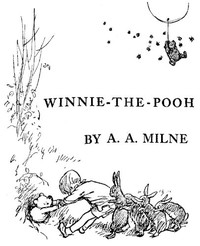
The source record for Winnie-the-Pooh — Context and Discussion measures this digital text at 26,338 words, 1 hr 55 min estimated reading time, and 5 detected text sections.
The text analysis averages about 13.0 words per sentence, while the detected sections provide another way to judge how the source is divided.
Project Gutenberg metadata also associates the work with “Animals -- Juvenile fiction,” connecting these edition facts with the source record’s subject description.
Explore this collection
These alternatives are selected using recorded categories and estimated reading time.
About 109 minutes
Science Fiction Utopias
25,064 recorded words. 6 minutes difference from this book's estimate.
View Gutenberg source #69443About 176 minutes
Science Fiction Utopias
40,450 recorded words. 61 minutes difference from this book's estimate.
View Gutenberg source #60133About 194 minutes
Science Fiction Utopias
44,481 recorded words. 79 minutes difference from this book's estimate.
View Gutenberg source #67206Search stored excerpts and compare books → Choose by your preferences →
Choices use stored catalog measurements. Estimates vary with reading speed. A shared category is a catalog label, not a claim that two books have the same argument or literary quality.
Search reads excerpt text stored with this catalog and links to its associated Gutenberg record. The connection is stored in the site database; this tool does not recheck that every excerpt is word-for-word identical to that external record. Excerpt search does not cover every chapter and does not verify historical publication dates.
Catalog snapshot checked: 2026-09-25. Coverage: 91 public books, 91 available source excerpts.
Read the complete public-domain text at its original source.
Read on Project GutenbergFrom the opening introduction, A. A. Milne establishes a distinctive narrative voice that treats the characters as real beings with their own agendas. The narrator reports Piglet's interruption—"What about Me?"—and then comments on Piglet's jealousy, blending third-person observation with a conspiratorial tone. This technique recurs throughout: the reader is invited to share in the joke of Pooh's limited understanding or Rabbit's self-importance. Milne's diction is precise yet playful, using capitalised phrases like "Generally Regarded as One of the Fiercer Animals" to mimic formal language while undercutting it with the absurd context. The result is a style that feels both intimate and gently ironic.
Milne's narrator does not merely describe events; he interacts with the characters and the reader. In the introduction, he writes, "I had written as far as this when Piglet looked up and said in his squeaky voice, 'What about Me?'" This direct address blurs the line between author and storyteller, making the reader a confidant. The narrator also editorialises—"Pooh is the favourite, of course, there's no denying it"—which adds a layer of affectionate mockery. This technique is consistent: later, when Rabbit reads his plan aloud, the narrator notes that "for a little while after he had read it nobody said anything," then describes Piglet's silent mouth movements. Such observations rely on precise timing and understatement, creating comedy through what is left unsaid.
Rabbit's speech is marked by a pseudo-official tone that contrasts with the forest setting. His "PLAN TO CAPTURE BABY ROO" is formatted with numbered points, subheadings like "General Remarks" and "More General Remarks," and cross-references ("See 2."). The language is deliberately inflated: "If we are to capture Baby Roo, we must get a Long Start, because Kanga runs faster than any of Us, even Me. (See 1.)" This mimics administrative writing, but the content is absurd—hiding a piglet in a kangaroo's pouch. Milne uses this contrast to satirise over-planning. Rabbit also uses capitalised phrases as if they were official terms: "Deprived of Its Young" and "Affectionate Disposition." These choices highlight Rabbit's need for control and his comedic self-importance.
Pooh's dialogue reveals a character who takes things at face value. When Rabbit says they will say "Aha!" to Kanga, Pooh practises the word in different tones, wondering "if Kanga will have to practise too so as to understand it." This literal interpretation of a social bluff exposes the gap between Rabbit's cunning and Pooh's simplicity. Pooh also accepts insults without resentment: when Rabbit says "you haven't any brain," Pooh replies "I know" humbly. Yet he finds pride in being called "Impossible without Me," repeating the phrase to himself. Milne's diction for Pooh is consistently simple—short sentences, concrete nouns, and a lack of abstraction—which makes his rare moments of self-awareness all the more affecting.
Piglet's voice is characterised by hesitation and self-doubt, conveyed through qualifiers and physical descriptions. He "fidgets" and speaks "huskily" after Rabbit's plan is read. His line "It is hard to be brave when you're only a Very Small Animal" uses the capitalised phrase to echo Rabbit's style, but the sentiment is genuine. Milne shows Piglet's internal conflict through small actions: "opening and shutting his mouth without making any noise" before managing to ask "And—Afterwards?" The dash and the single-word question convey his dread more effectively than any exposition. Piglet's vocabulary is slightly more elaborate than Pooh's—he uses words like "Generally Regarded"—but his syntax is halting, reflecting his nervousness. These linguistic details make his courage feel earned.
Milne's authorial choices in Winnie-the-Pooh reward close attention to how characters speak and how the narrator frames their words. The humour arises not from events but from the gap between formal language and childish concerns, between Rabbit's grand plans and Pooh's literal replies. Readers may find additional pleasure in tracking the narrator's asides or the way capitalised phrases migrate from one character to another. The text invites us to listen as much as to read.
Years among the stacks, and I’ve noticed how Pooh’s gentle, literal mind finds a strange echo in Little Baron Trump’s grand, wonderfully earnest wanderings. Both books share a quiet patience with the world, letting nonsense breathe into sense. Their kinship is a comfort, like finding an old friend’s handwriting. Travels and Adventures of Little Baron Trump and His Wonderful Dog Bulger — A Reader’s Guide sits beside my Milne notes, a pleasant, unhurried pairing.
Capture what you thought, learned, and would like to remember.