About 322 minutes
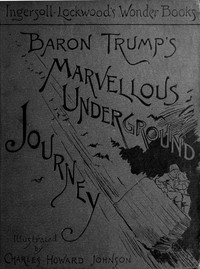
Baron Trump's Marvellous Underground Journey — Reading Notes
Science Fiction Utopias
73,926 recorded words. 109 minutes difference from this book's estimate.
View Gutenberg source #57426
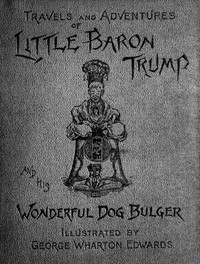
The catalog record for Travels and Adventures of Little Baron Trump and His Wonderful Dog Bulger — A Reader’s Guide provides practical reading context through 99,014 words, 7 hr 11 min estimated reading time, and 20 detected text sections.
The text analysis averages about 19.8 words per sentence, while the detected sections provide another way to judge how the source is divided.
Project Gutenberg metadata also associates the work with “Fantasy fiction,” connecting these edition facts with the source record’s subject description.
Explore this collection
These alternatives are selected using recorded categories and estimated reading time.
About 322 minutes
Science Fiction Utopias
73,926 recorded words. 109 minutes difference from this book's estimate.
View Gutenberg source #57426About 304 minutes
Science Fiction Utopias
69,761 recorded words. 127 minutes difference from this book's estimate.
View Gutenberg source #67723About 294 minutes
Science Fiction Utopias
67,560 recorded words. 137 minutes difference from this book's estimate.
View Gutenberg source #57165Search stored excerpts and compare books → Choose by your preferences →
Choices use stored catalog measurements. Estimates vary with reading speed. A shared category is a catalog label, not a claim that two books have the same argument or literary quality.
Search reads excerpt text stored with this catalog and links to its associated Gutenberg record. The connection is stored in the site database; this tool does not recheck that every excerpt is word-for-word identical to that external record. Excerpt search does not cover every chapter and does not verify historical publication dates.
Catalog snapshot checked: 2026-09-25. Coverage: 91 public books, 91 available source excerpts.
Read the complete public-domain text at its original source.
Read on Project GutenbergThe little Baron Trump is no ordinary traveler. In the opening chapters, he dismisses his tutors and sets off on a series of voyages that take him from the Land of the Melodious Sneezers to the edge of the Great Gloomy Forest. His constant companion is Bulger, a dog whose loyalty and intelligence prove as vital as the Baron's own wits. The narrative voice is brisk and self-assured, mixing mock-heroic adventure with a cataloguer's delight in strange customs.
What distinguishes this book from a simple picaresque is the Baron's habit of interpreting each new culture through a scholarly lens. When he hears of the Palin-mâ-Talin, he immediately identifies it as the Great Aryan Forest, a place where humanity first learned to hunt. This blend of fantasy and pseudo-anthropology gives the story an unusual texture, as if Jules Verne had rewritten the Odyssey with a dog as co-pilot.
The excerpt featuring Benè-agâ, the blind hermit, is the most striking passage in the available text. The Baron's guide warns him that the Great Gloomy Forest is "as pathless as the ocean, as silent as death, as limitless as the heavens." Yet when the Baron learns that a blind man has crossed it, he is not deterred but intrigued. The hermit's blindness is presented not as a disability but as a kind of inner illumination: "in him dwells such a radiant spirit, that his path is illumined."
This inversion—where physical sight is less reliable than spiritual vision—is a recurring motif. The Baron's guide, who can see, is terrified; the blind hermit, who cannot, is the only one who can lead. The Baron himself is a figure of restless curiosity, willing to risk everything for the sake of discovery. The contrast between the guide's fear and the Baron's eagerness creates a tension that drives the narrative forward.
The little Baron is not a muscle-bound adventurer but a bookish one. He discharges his tutors, solves his father's financial worries, and interprets a Roman newspaper as a clue to a lost island. His method is to observe, classify, and deduce. When he encounters the Wind Eaters, he does not simply fight them; he studies their habits and finds a way to outwit them.
This intellectual approach is reinforced by the narrative's structure. Each chapter is a self-contained episode, often introduced by a problem that the Baron must solve through a combination of reading, reasoning, and bold action. The dog Bulger is not just a pet but a partner, whose timely arrivals and sharp senses repeatedly save the Baron's life. The partnership between a thinking boy and a loyal dog gives the story a warmth that balances its more fantastical elements.
The book opens with a genealogy: the little Baron is descended from the "Armless Knight," a famous ancestor. His father, the elder Baron, made the ascent of the Mountains of the Moon and escaped an impenetrable fog. This backstory establishes a pattern of inherited adventure. The little Baron is not striking out into the unknown on a whim; he is fulfilling a family destiny.
Yet the elder Baron is also a figure of comic anxiety. He worries about the investment of his son's fortune, loses flesh from stress, and objects to the little Baron's travels. The son must overcome this opposition by clever means. This tension between the pull of adventure and the drag of domestic responsibility gives the story a psychological dimension. The little Baron is not just a wanderer; he is a son negotiating his independence, and his journeys are as much about proving himself as about discovering new lands.
Readers should approach Travels and Adventures of Little Baron Trump as a hybrid work: part adventure story, part intellectual puzzle, part family comedy. The Baron's voice is distinctive—learned, playful, and self-aware—and the episodic structure makes it easy to dip in and out. Pay attention to the way the Baron interprets each strange culture; his scholarly asides are as entertaining as the action. And keep an eye on Bulger, whose barks and bounds often signal the turning point of an episode.
Somewhere in the Baron’s cheerful wanderings, there’s a quiet ache—how the blind hermit Benè-agâ sees more through memory than sight. That same patient honesty lingers by another fireside, where a young Californian weighs bright promises against the weight of truth. Both books share that tender, unhurried glance at what glitters and what endures. "All's not Gold that Glitters;" or, The Young Californian — Key Ideas to Explore has kept that companionship for me over the years.
Your answers remain private and are stored only in this browser.