About 297 minutes
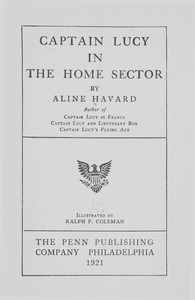
Captain Lucy in the Home Sector — A Reader’s Guide
Historical Psychological Social Fiction
68,126 recorded words. 1 minutes difference from this book's estimate.
View Gutenberg source #57362

This digital edition of Betty Wales on the campus — Background and Themes is described by source-level measurements including 68,514 words, 4 hr 58 min estimated reading time, and 24 detected text sections.
The text analysis averages about 16.0 words per sentence, while the detected sections provide another way to judge how the source is divided.
Project Gutenberg metadata also associates the work with “Schools -- Juvenile fiction,” connecting these edition facts with the source record’s subject description.
Explore this collection
These alternatives are selected using recorded categories and estimated reading time.
About 297 minutes
Historical Psychological Social Fiction
68,126 recorded words. 1 minutes difference from this book's estimate.
View Gutenberg source #57362About 290 minutes
Historical Psychological Social Fiction
66,498 recorded words. 8 minutes difference from this book's estimate.
View Gutenberg source #61673About 271 minutes
Historical Psychological Social Fiction
62,220 recorded words. 27 minutes difference from this book's estimate.
View Gutenberg source #61208Search stored excerpts and compare books → Choose by your preferences →
Choices use stored catalog measurements. Estimates vary with reading speed. A shared category is a catalog label, not a claim that two books have the same argument or literary quality.
Search reads excerpt text stored with this catalog and links to its associated Gutenberg record. The connection is stored in the site database; this tool does not recheck that every excerpt is word-for-word identical to that external record. Excerpt search does not cover every chapter and does not verify historical publication dates.
Catalog snapshot checked: 2026-09-25. Coverage: 91 public books, 91 available source excerpts.
Read the complete public-domain text at its original source.
Read on Project GutenbergIn Betty Wales on the Campus, Edith K. Dunton builds scenes almost entirely through dialogue, letting characters reveal themselves by what they say and how they say it. The excerpt shows Madeline Ayres defending her decision to write a play instead of helping with the gift-shop, and her speech is peppered with confident assertions: “I have discovered the secret of writing natural but amusing dialogue.” Mary Brooks, by contrast, uses sarcasm and playful threats like “I shall cross my thumbs at you and your old play.” Betty Wales, caught between them, speaks in hesitant questions and sighs. These verbal tics are not accidental; they form a consistent pattern across the series, marking each girl’s role in the group.
Dunton’s dialogue does more than advance plot—it defines personality through rhythm and word choice. Madeline Ayres speaks in long, reasoned declarations, often beginning with “In the first place” or “In the second place,” signaling her methodical self-confidence. Mary Brooks interrupts with sharp, humorous retorts: “A play is any amount harder to write than a short story.” Betty Wales, the nominal leader, rarely asserts herself directly; her lines are questions (“What shall I do?”) or murmured asides (“Betty murmured under her breath”). This contrast establishes a hierarchy of assertiveness without explicit narration.
The author also uses dialogue to show shifting alliances. When Mary switches from opposition to support—“I’ll cross my thumbs for your play instead of against it”—the change is marked by a single line, not internal monologue. Dunton trusts readers to hear the shift in tone.
The group of friends is referred to as “the B. C. A.’s,” a nickname that appears without explanation, suggesting an established in-group code. Such abbreviations and inside references recur throughout the series, creating a sense of shared history. In the excerpt, Mary calls Madeline “the most provoking but also pretty nearly the most interesting of all the B. C. A.’s.” The phrase is both teasing and affectionate, typical of the banter that defines their relationships.
Dunton also uses invented terms like “Ploshkin” (mentioned in the introduction) to build a world of private jokes and campus traditions. These linguistic markers reinforce the insular, self-contained society of Harding College, where friendships are cemented through shared vocabulary.
Work—whether writing a play, running a gift-shop, or studying—is a constant topic, and characters discuss it with a blend of practicality and idealism. Madeline frames her playwriting as a strategic career move: “every Tom, Dick and Harry is writing good short stories nowadays, and nobody is writing extra good plays.” Her language is analytical, almost businesslike. Mary counters with pragmatic concerns: “The gift-shop pays splendidly.” Betty worries about disappointing “Mrs. Hildreth and Mrs. Bob,” showing that her motivation is social obligation rather than personal gain.
Dunton avoids sentimentalizing labor. The girls argue about time management and profit margins, not dreams. Even Madeline’s artistic ambition is couched in terms of market gaps and secret methods. This matter-of-fact tone gives the novel a grounded, unsentimental quality rare in juvenile fiction of the period.
Though the story is told in third person, the narrator rarely intrudes. Descriptions are minimal; the excerpt contains no scenic detail beyond “the workroom.” Instead, the narrator reports speech and gesture: “Betty and Mary exchanged glances of utter amazement.” This technique keeps the focus on what characters say and do, not on what they feel. When the narrator does comment, it is often with dry understatement: “Mary was nothing if not persistent.”
The effect is a style that feels modern in its restraint. Dunton trusts her readers to infer emotion from dialogue and action. The narrator’s voice is that of an observer, not a commentator, which aligns with the book’s emphasis on social interaction over interiority.
Readers coming to this installment after earlier books will recognize the familiar cadences of the B. C. A.’s conversations. New readers, however, can quickly grasp the dynamics through Dunton’s careful use of dialogue as a tool for characterization. Pay attention to who speaks in complete sentences, who interrupts, and who asks questions—these patterns reveal more than any summary could. The novel rewards close attention to its verbal texture.
That rainy afternoon I kept noticing how Betty’s friends finished each other’s sentences, their words braided tight by shared history. Diction as intimacy, I wrote in the margin. Later, idly, I opened The Charterhouse of Parma, Volume 1 — Edition Insights, and felt the same quiet thrill—how Stendhal’s silences between dialogues carry just as much weight as the talk itself.
Use these questions to collect your thoughts before moving on.