About 488 minutes
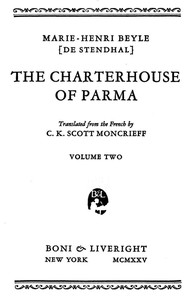
The Charterhouse of Parma, Volume 2 — A Closer Reading
Historical Psychological Social Fiction
112,091 recorded words. 51 minutes difference from this book's estimate.
View Gutenberg source #66375
The source record for The Charterhouse of Parma, Volume 1 — Edition Insights measures this digital text at 123,850 words, 8 hr 59 min estimated reading time, and 11 detected text sections.
The text analysis averages about 25.1 words per sentence, while the detected sections provide another way to judge how the source is divided.
Project Gutenberg metadata also associates the work with “Love stories,” connecting these edition facts with the source record’s subject description.
Explore this collection
These alternatives are selected using recorded categories and estimated reading time.
About 488 minutes
Historical Psychological Social Fiction
112,091 recorded words. 51 minutes difference from this book's estimate.
View Gutenberg source #66375About 385 minutes
Historical Psychological Social Fiction
88,548 recorded words. 154 minutes difference from this book's estimate.
View Gutenberg source #58410About 340 minutes
Historical Psychological Social Fiction
78,103 recorded words. 199 minutes difference from this book's estimate.
View Gutenberg source #62829Search stored excerpts and compare books → Choose by your preferences →
Choices use stored catalog measurements. Estimates vary with reading speed. A shared category is a catalog label, not a claim that two books have the same argument or literary quality.
Search reads excerpt text stored with this catalog and links to its associated Gutenberg record. The connection is stored in the site database; this tool does not recheck that every excerpt is word-for-word identical to that external record. Excerpt search does not cover every chapter and does not verify historical publication dates.
Catalog snapshot checked: 2026-09-25. Coverage: 91 public books, 91 available source excerpts.
Read the complete public-domain text at its original source.
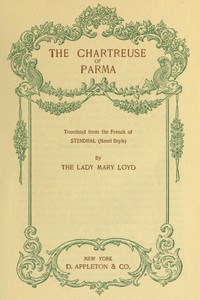
Read on Project GutenbergStendhal opens The Charterhouse of Parma with a brisk, ironic narrative voice that immediately establishes the novel's psychological and political terrain. The first chapter introduces Fabrizio del Dongo as a young man swept up in Napoleonic fervor, but the author's diction—words like "singular position" and "vulgar and coarse"—signals a world where appearances and self-interest govern behavior. The dialogue between Signora Pietranera and Conte Mosca, with its frank admissions about powdering hair and stolen pensions, exemplifies Stendhal's method: characters reveal themselves through what they say and what they omit. The translator, C. K. Scott-Moncrieff, preserves the rapid, conversational rhythm that makes these exchanges feel both intimate and calculating.
Stendhal’s word choices often carry a double edge. When Signora Pietranera finds the men she meets "vulgar and coarse," the adjectives reflect not just her judgment but the novel’s social milieu—a world where refinement masks ambition. The narrator describes Conte Mosca’s "strongly marked features, with no trace of self-importance," a phrase that hints at the performance of modesty. Later, Mosca admits he "dress[es] up like an actor in a farce" to win position, using theatrical language that undercuts his own authority. These lexical patterns recur: characters speak of "glory" and "intrigue" in the same breath, collapsing heroic ideals into pragmatic calculation. Stendhal rarely explains; he lets the diction imply the gap between what people say and what they do.
The conversation in the opera box between Signora Pietranera and Conte Mosca is a masterclass in Stendhalian dialogue. It begins with a personal observation—"why do you powder your hair?"—that breaks social convention and establishes intimacy. Mosca’s reply, "Because, in the said Spain, I stole nothing, and one must live," is disarmingly honest yet strategically self-deprecating. The exchange moves rapidly from confession to flirtation to political analysis, each line advancing both character and plot. Stendhal uses dialogue to expose motives: Mosca’s longing for the "spirit of your Army of Italy" reveals nostalgia for a lost cause, while Signora Pietranera’s questions probe his sincerity. The rhythm is quick, with few authorial interruptions, forcing the reader to infer the subtext.
Stendhal structures the opening chapters to alternate between action and reflection. Fabrizio’s journey to Waterloo is narrated in swift, almost breathless prose, while the Milanese scenes slow to allow psychological portraiture. This contrast mirrors the novel’s thematic tension: the desire for heroic action versus the reality of political maneuvering. The narrator’s asides—such as noting that "people have little fear of wounding one another's vanity" in Italy—serve as compressed social commentary. Stendhal also uses chapter breaks to shift perspective, moving from Fabrizio’s naive enthusiasm to the calculating world of the Parma court. The effect is a narrative that feels both episodic and tightly controlled, each scene building toward the intricate power games that define the rest of the volume.
The novel’s settings are rendered with precise, economical detail. Milan’s La Scala is not just a theater but a space for political networking and emotional refuge: Signora Pietranera "would go and shut herself up alone for hours on end, at the Scala, in the box of her old friend." The opera box becomes a stage within the stage, where alliances are formed and secrets exchanged. Parma, by contrast, is evoked through Mosca’s description of his "huge palazzo, half-finished"—a symbol of unfinished ambitions and the compromises of exile. Stendhal avoids lengthy descriptions; instead, he embeds setting in character action. The powder on Mosca’s hair, required by his Prince, is a detail that condenses an entire political system into a single image. Place, in Stendhal, is never neutral; it is always charged with social meaning.
Readers attentive to Stendhal’s diction will notice how often characters use words like "amuse" and "enjoyment" to describe relationships that are actually strategic. The novel rewards careful attention to what is left unsaid—the pauses, the evasions, the sudden shifts in tone. Scott-Moncrieff’s translation captures this subtlety, making the English text a reliable guide to Stendhal’s psychological realism. Approach this volume as a study in how people present themselves, and you will find its ironies deepen with each chapter.
In The Charterhouse of Parma, I often think of Fabrizio’s quiet bewilderment at Waterloo—how a young soul stumbles through grand events, feeling everything yet understanding little. That same tender disorientation lives in Betty Wales on the campus — Background and Themes, where a new world unfolds slowly, and one simply watches the heart find its footing.
A brief reflection can help important ideas stay with you longer.