About 539 minutes
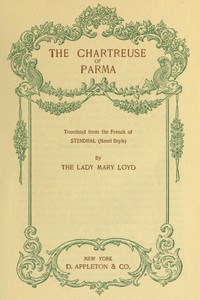
The Charterhouse of Parma, Volume 1 — Edition Insights
Historical Psychological Social Fiction
123,850 recorded words. 51 minutes difference from this book's estimate.
View Gutenberg source #66374
The Charterhouse of Parma, Volume 2 — A Closer Reading can be approached with a clearer sense of reading commitment from its source measurements: 112,091 words, 8 hr 8 min estimated reading time, and 9 detected text sections.
The text analysis averages about 27.9 words per sentence, while the detected sections provide another way to judge how the source is divided.
Project Gutenberg metadata also associates the work with “Love stories,” connecting these edition facts with the source record’s subject description.
Explore this collection
These alternatives are selected using recorded categories and estimated reading time.
About 539 minutes
Historical Psychological Social Fiction
123,850 recorded words. 51 minutes difference from this book's estimate.
View Gutenberg source #66374About 385 minutes
Historical Psychological Social Fiction
88,548 recorded words. 103 minutes difference from this book's estimate.
View Gutenberg source #58410About 340 minutes
Historical Psychological Social Fiction
78,103 recorded words. 148 minutes difference from this book's estimate.
View Gutenberg source #62829Search stored excerpts and compare books → Choose by your preferences →
Choices use stored catalog measurements. Estimates vary with reading speed. A shared category is a catalog label, not a claim that two books have the same argument or literary quality.
Search reads excerpt text stored with this catalog and links to its associated Gutenberg record. The connection is stored in the site database; this tool does not recheck that every excerpt is word-for-word identical to that external record. Excerpt search does not cover every chapter and does not verify historical publication dates.
Catalog snapshot checked: 2026-09-25. Coverage: 91 public books, 91 available source excerpts.
Read the complete public-domain text at its original source.
Read on Project GutenbergThe Duchessa's reaction to Fabrizio's impending sentence—summoning servants, distributing ten years' wages, and departing for Florence without consulting Conte Mosca—immediately establishes her as a force of impulsive, theatrical defiance. Stendhal juxtaposes her grand gesture with the Fiscal General Rassi's legal maneuvering, which treats Fabrizio's case as though he were a Liberal, a phrase that hints at the political subtext beneath the personal drama.
Later, the narrative narrows to Fabrizio's cell, where the governor's collapse and Clelia's vow to the Virgin introduce a claustrophobic, morally charged atmosphere. Her letter, hidden beneath fruit, blends religious scruple with practical escape plans, signaling that the volume's core tension lies not in courtroom battles but in the psychology of confinement and choice.
The opening excerpt shows the Duchessa acting on a single piece of news—the Raversi faction's announcement—with a speed that bypasses her ally Conte Mosca. Her speech to the servants, offering ten years' wages and a promise of future aid, is both generous and strategic: it secures loyalty while staging a public performance of righteous indignation. Stendhal notes that she meant exactly what she said, yet her tears and the servants' weeping create a scene that blurs sincerity with theater. The phrase we shall see him come again reveals her underlying confidence, but the decision to leave without informing the Conte suggests a private game of power, not mere maternal concern.
Clelia's letter to Fabrizio is the volume's emotional pivot. She frames her actions as penance for an unnamed idea that endangered her father, vowing to obey him and marry the Marchese. Yet she continues to facilitate the escape, using a coded system: a black dress at the window signals readiness, a lamp indicates the decisive moment. The letter's tone oscillates between religious submission (I have made my vow) and desperate affection (if you perish, my heart will be broken). Stendhal embeds the escape plan in a web of moral compromise—Clelia cannot look at Fabrizio again, yet she provides money, poison, and cords sent by that terrible woman, the Duchessa.
A brief but striking passage describes the prisoners' reaction to Fabio Conti's recovery: they order a Te Deum and compose sonnets in his honor, despite his cruelty. Stendhal interrupts the narrative with an exclamation—Oh, the effect of misery upon men!—and a direct challenge to the reader: May he who would blame them be led by his destiny to spend a year in a cell three feet high. This authorial intrusion, rare in the excerpts, underscores the dehumanizing conditions of the citadel. The detail of prisoners in dungeons where they can neither stand nor sit contrasts sharply with Fabrizio's relatively comfortable cell, reminding us that his plight, though dire, is not the worst.
Clelia's letter transforms the escape from a practical problem into a moral test. She instructs Fabrizio to prepare his soul and dress in a priestly habit, framing the flight as a quasi-religious ordeal. The mention of poison alongside cords suggests that failure is expected to end in suicide rather than recapture. The Duchessa, described as that terrible woman who loves you with passion, looms as a manipulative force, yet Clelia acknowledges her authority. The signal system—mass, black dress, lamp—creates a rhythm of anticipation that replaces the political machinations of earlier chapters. For a first-time reader, the question is not whether Fabrizio will escape, but what he will become if he does.
These excerpts reward attention to the characters' internal calculations—the Duchessa's theatrical generosity, Clelia's divided loyalties, Fabrizio's passive reception of others' plans. Stendhal's narrator occasionally steps forward to comment on human misery or political hypocrisy, but the story's engine is the tension between public performance and private desperation. Readers may find that the volume's power lies less in the escape itself than in the moral compromises that precede it.
The rain kept time with Fabrizio’s locked hours, the Duchessa’s letters barely breathing between walls. That afternoon, I set the volume down, restless. My eye caught another spine on the shelf, and I pulled it open—Betty Wales on the campus — Background and Themes. Different world, yet the same quiet ache of waiting for a door to unbar. I read on, the drizzle never noticing.
A brief reflection can help important ideas stay with you longer.