About 539 minutes
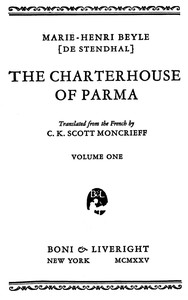
The Charterhouse of Parma, Volume 1 — Edition Insights
Historical Psychological Social Fiction
123,850 recorded words. 347 minutes difference from this book's estimate.
View Gutenberg source #66374
The catalog record for The Chartreuse of Parma Translated from the French of Stendhal (Henri Beyle) — Story, Setting & Ideas provides practical reading context through 203,699 words, 14 hr 46 min estimated reading time, and 17 detected text sections.
The text analysis averages about 20.7 words per sentence, while the detected sections provide another way to judge how the source is divided.
Project Gutenberg metadata also associates the work with “Love stories,” connecting these edition facts with the source record’s subject description.
Explore this collection
These alternatives are selected using recorded categories and estimated reading time.
About 539 minutes
Historical Psychological Social Fiction
123,850 recorded words. 347 minutes difference from this book's estimate.
View Gutenberg source #66374About 488 minutes
Historical Psychological Social Fiction
112,091 recorded words. 398 minutes difference from this book's estimate.
View Gutenberg source #66375About 385 minutes
Historical Psychological Social Fiction
88,548 recorded words. 501 minutes difference from this book's estimate.
View Gutenberg source #58410Search stored excerpts and compare books → Choose by your preferences →
Choices use stored catalog measurements. Estimates vary with reading speed. A shared category is a catalog label, not a claim that two books have the same argument or literary quality.
Search reads excerpt text stored with this catalog and links to its associated Gutenberg record. The connection is stored in the site database; this tool does not recheck that every excerpt is word-for-word identical to that external record. Excerpt search does not cover every chapter and does not verify historical publication dates.
Catalog snapshot checked: 2026-09-25. Coverage: 91 public books, 91 available source excerpts.
Read the complete public-domain text at its original source.
Read on Project GutenbergStendhal opens The Chartreuse of Parma with a court scene that immediately establishes the novel's satirical edge. The prince, in a morning audience with Chief-Justice Rassi, dictates a sentence for Fabrizio del Dongo with theatrical precision: twelve years' detention, a public apology, and weekly walks on the Farnese Tower. Rassi, described as 'still standing doubled up in an attitude of obeisance,' embodies the sycophancy that pervades the Parmese court. The prince's offhand remark to 'keep your lips sealed' and his refusal to acknowledge Rassi's bows reveal a ruler who treats justice as a performance.
The excerpt's diction sharply delineates the prince's authority from Rassi's servility. The prince speaks in clipped commands: 'Write,' 'Give the paper to me to sign,' 'Sign that.' His language is transactional, reducing a man's fate to a bureaucratic exercise. Rassi, by contrast, is described in terms of physical subservience—'doubled up,' 'making three deep bows, very slowly indeed'—and his speech is limited to a deferential 'Yes, your Most Serene Highness.' The prince's final instruction, 'keep your lips sealed, whatever you may hear in the town,' underscores a regime where silence is enforced. This contrast in voice mirrors the broader power dynamics: the prince's casual cruelty versus the courtiers' calculated compliance.
Stendhal uses setting to reinforce the novel's political machinations. The prince's audience occurs 'at seven o'clock in the morning,' an early hour that suggests the relentless nature of court life. The 'Farnese Tower' is named with a dismissive 'vulgarly called,' hinting at the gap between official titles and common usage. Later, the 'café politicians' and the rumor mill—'the news of the Marchesa Raversi’s exile had spread all over the town and the cafés'—show how information circulates through Parma's public spaces. The archbishop's 'zeal in our hero’s cause was largely paralyzed' by a false rumor, demonstrating how setting and gossip intertwine to drive plot. The country house at Velleia becomes a rival court, where the exiled marchesa gathers 'quite thirty persons' to plot.
A striking motif in the excerpt is the threat of 'boredom' (ennui) that haunts the Parmese court. The narrator notes that the marchesa's banishment 'fled from the town of Parma' the 'implacable enemy of small cities and small courts, known as boredom.' This personification elevates tedium to a political force. The prince's theatrical sentencing—complete with a portrait, a fast, and a public apology—reads as a performance designed to entertain or distract. The 'middle class, and consequently the populace' interpret events as signs of an impending archbishopric, revealing how the court's dramas are consumed as spectacle. Even the prince's 'graciousness' toward the marchesa's friends is a calculated act. Stendhal thus frames political intrigue as a remedy for collective ennui.
Lady Mary Loyd's 1901 translation shapes the novel's tone through specific lexical choices. The prince's command to 'break the neck of his career' is a vivid, colloquial phrase that retains Stendhal's bluntness. The description of Rassi 'doubled up in an attitude of obeisance' uses formal, almost theatrical language, mirroring the original's ironic distance. Loyd preserves the narrator's dry asides, such as 'All this happened at seven o'clock in the morning,' which undercuts the drama with mundane detail. She also renders the prince's dialogue in curt, imperative sentences, maintaining the character's imperiousness. While a comparison with the French would be needed to assess fidelity, Loyd's English version conveys the novel's satirical edge and psychological acuity.
Readers approaching The Chartreuse of Parma should attend to Stendhal's use of indirect narration: the narrator often reports events through the lens of rumor, speculation, or characters' limited perspectives. The excerpt's café gossip and the archbishop's paralyzed zeal exemplify this technique. The novel rewards attention to small gestures—a bow, a signature, a rumor—that accumulate into a portrait of a society where power is performed and justice is a script.
Years after shelving Lady Mary Loyd’s translation of The Chartreuse of Parma, I found myself returning to its glittering, dangerous court—that careless prince, Rassi’s bowed head. Then I pulled out Partners Three — Reading Notes, and there it was: the same patient, ironic watching of power’s little follies. Some books simply recognize one another.
Build a private reading journal entry for this title.